A new preprint article from Taryn Tieu and Prof. Vanessa Coehlo-Santos, during their time in the lab, uses high-resolution two-photon imaging to study the physiological and injury-induced dynamics of microglia across the life-span. Their results show how microglial in the developing brain are highly mobile but less coordinated in their response to tissue and vascular injury compared to the adult brain. In the aged brain, microglia mount coordinated responses to focal injury, but are slower and less sensitive.

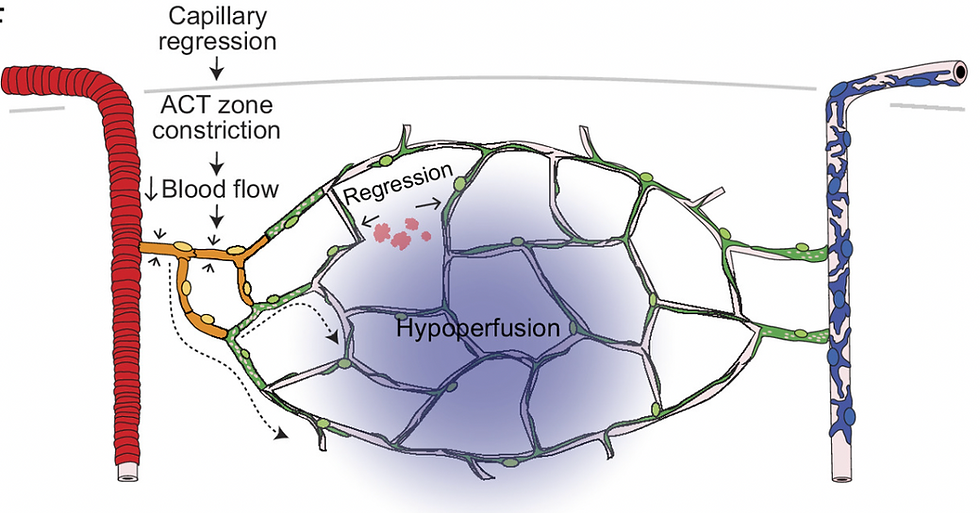
A gradual loss of capillary density occurs with normal aging and is exacerbated by vascular pathologies associated with dementia. Recent studies also showed that the capillary network behaves like a sensory web, conducting signals upstream during physiological blood flow control. However, it was unknown how this network behaves with capillary regression. A new PNAS paper recently published by Dr. Stephanie Bonney, Cara Nielson and Maria Sosa used precise laser ablations to remove individual capillary segments from the capillary network. Surprisingly, they found that loss of capillaries led to upstream vasoconstriction lasting several weeks and leading to reduced perfusion of downstream capillaries. These findings suggest that capillary regression add new insight into how capillary regression is linked to cerebral hypoperfusion in age-related diseases. See also, a great commentary written by Prof. Baptiste Lacoste.